
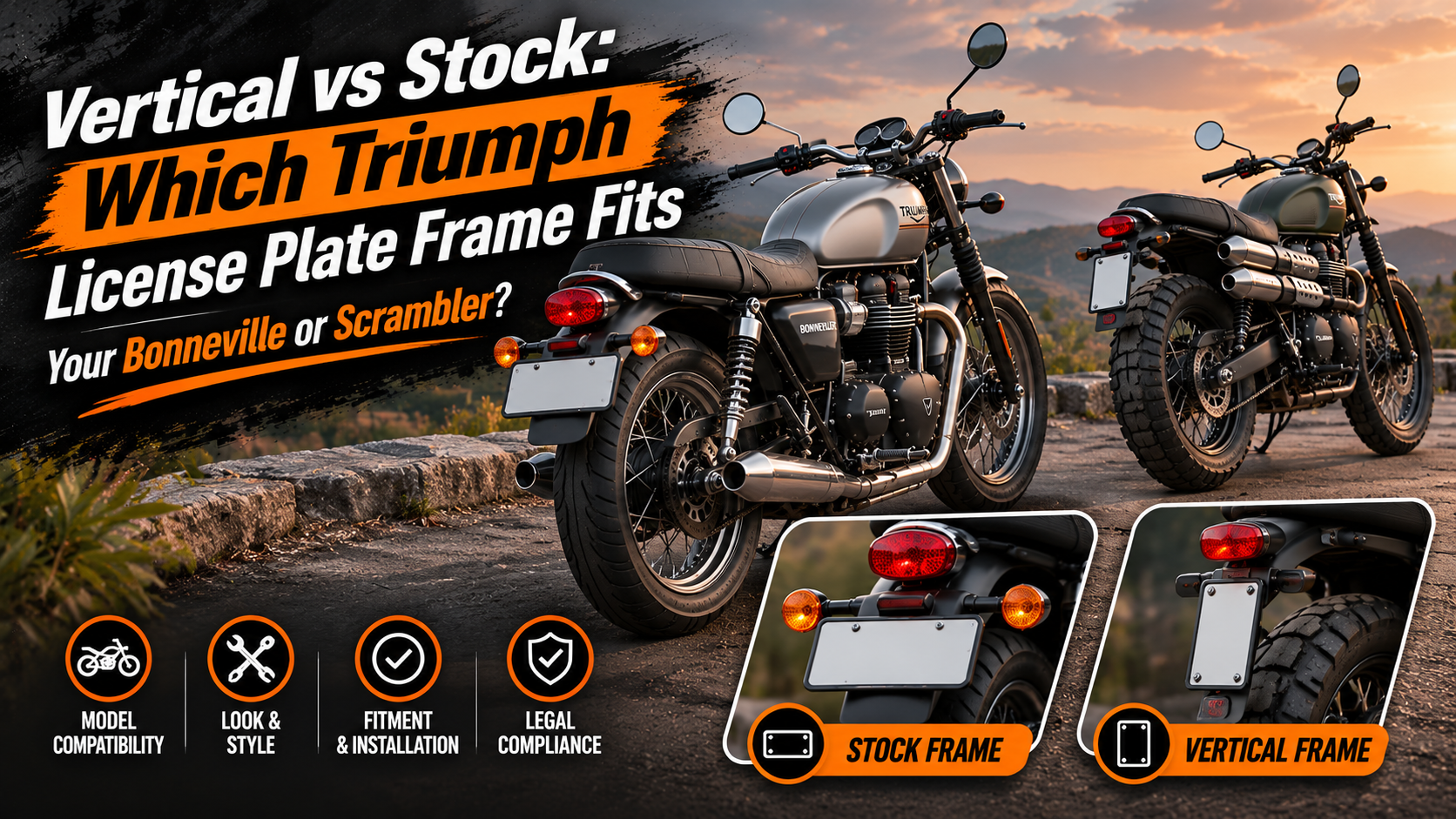
A lot of Triumph owners pull the bulky rear fender, admire the clean tail for a weekend, then realize the plate has nowhere legal to go.
Choosing the right Triumph license plate frame setup before you start saves that headache. It also decides how the back of your Bonneville, Thruxton or Scrambler looks every time you walk up to it.
There are three realistic paths: keep the stock setup, move the plate to a vertical side mount, or fit a fender eliminator plate mount. Each one trades looks, practicality and legal simplicity differently.
This guide helps you decide:
What each plate setup looks like and how it mounts
Why most universal side mounts do not suit a Triumph
Which option fits your model and riding style
What to check legally before you ride
Which Triumph License Plate Frame Setup Should You Choose?
Choose a vertical side mount if you want the cleanest possible tail and your state allows a vertically displayed plate. Choose a fender eliminator plate mount if you want to remove the bulky fender but keep the plate behind the bike in the conventional position. Keep the stock setup if legal simplicity matters most or you plan to sell the bike soon. Whichever you pick, buy a mount made for Triumph models, because the Triumph swingarm will not accept most universal vertical mounts. Check your state's plate display and lighting rules before you order anything.
Why So Many Riders Replace the Stock Plate Setup
The Triumph Bonneville family has a classic profile that many owners want to show off. The factory plate hardware hangs off a long rear fender, which hides the tire and makes the tail look heavier than the rest of the bike.
Moving the plate is one of the most visible changes you can make for the money. It changes the bike's silhouette from every angle behind the rider.
If you want the background on why riders remove fenders in the first place, our guide to fender eliminators explained covers it in detail.
Your Three Options Explained
Each option solves the same problem in a different way. Here is what you are actually choosing between.
Option 1: Keep the Stock Setup
The factory setup keeps the plate where Triumph designed it, with the original lighting and placement. It is the least exciting option, but it is also the simplest when it comes to legality.
No new parts, wiring or installation work
Factory plate lighting already in place
The heaviest look of the three options
Stock is the smart choice in a few situations, even for riders who love custom bikes:
You ride in a state with strict plate display rules
You plan to sell the bike soon and want to keep it original
You carry a passenger often and value the fender's spray protection
You would rather spend the budget on exhaust or suspension first
There is no shame in waiting. A plate mount is an easy change to make later.
Option 2: A Vertical License Plate Motorcycle Setup
A vertical license plate motorcycle setup moves the plate beside the rear wheel, turned on its side. That frees the entire tail, so you can run a short fender or none at all.
Kinetic's Triumph vertical license plate mount attaches at the axle and is designed to fit snugly so you can torque the axle nut correctly. It is CNC cut from steel, finished in matte black powder coat, and costs $55.
The product page does not state that a plate light is included, so plan your lighting separately if your state requires it.
Pros and cons of going vertical:
Pro: the cleanest, most custom tail of any option
Pro: frees space for a short fender or none at all
Con: some states restrict vertical plate display
Con: the plate sits closer to road spray from the rear tire
Option 3: A Fender Eliminator Plate Mount
A fender eliminator keeps the plate behind the bike but removes the rear fender completely. Kinetic's Fender Eliminator License Plate Mount is CNC cut from steel, finished in matte black powder coat and made to US motorcycle plate specifications.
It starts at $70 and offers an optional LED tail light with integrated turn signals. If you choose the LED version, use the wire connectors included with the kit.
Pros and cons of a fender eliminator:
Pro: plate stays in the conventional position behind the bike
Pro: optional LED kit updates lighting at the same time
Con: the tail is cleaner than stock but not fully open
Con: the rear tire is more exposed without the fender
Five Questions to Answer Before You Buy
A few minutes of planning prevents most plate mount regrets. Answer these before you order:
Does my state allow a vertically displayed motorcycle plate?
Will I keep any part of the rear fender, or remove it completely?
Do I need a new plate light, turn signals or both?
Which side is my exhaust on, and how close is the chain?
Am I comfortable working on the rear axle, or will a shop fit it?
Your answers usually point clearly to one of the three setups.
Stock vs Vertical vs Fender Eliminator Compared
Here is how the three setups compare, using the details listed on Kinetic's product pages for the two aftermarket options.
Why a Universal Mount Often Will Not Work on a Triumph
Universal side mounts look like an easy shortcut. On a Triumph, they often are not.
Kinetic states plainly that the swingarm design on Triumph models will not accept most vertical license plate mounts. A mount that does not seat properly can also interfere with how the axle nut is tightened.
Buy a mount designed for your Triumph model family
Make sure it sits flush where it meets the axle
Confirm you can torque the axle nut to the factory specification
Which Triumph License Plate Frame Fits Your Bonneville, Thruxton or Scrambler?
Both Kinetic plate mounts are listed for Bonneville, Thruxton and Scrambler models. The right choice depends more on how you ride than which badge is on the tank.
Triumph reworked the Bonneville family as a liquid-cooled range from 2016, with 900cc and 1200cc models. Neither Kinetic listing names specific years, so confirm your year and model with Kinetic before ordering.
Bonneville and Thruxton
These are road-focused bikes, so the look of the tail matters most. A vertical mount gives the most minimal profile, while a fender eliminator keeps the plate in a familiar position with a tidier finish.
Choose vertical for a stripped, custom look
Choose a fender eliminator for a cleaner but traditional rear plate
Consider the optional LED kit if you also want new signals
Scrambler
The Triumph Scrambler name has long been tied to a high-mounted exhaust. Before you choose a side mount, check which side the plate will sit on and how close it comes to your pipe and chain.
Confirm clearance between the plate, exhaust and chain
Think about mud and debris if you ride unpaved roads
Changing the exhaust too? Read our guide to Triumph exhaust upgrades before you finalize the layout
Match the Setup to Your Goal
If you are still undecided, start with what matters most to you.
Finishing the Tail After You Move the Plate
Once the plate is relocated, the rear of the bike often looks unfinished. Two parts help close the gap.
A shorty fender hand formed from 6061 aluminum, eight inches long, with a mounting tab and hardware included; the listing does not name models, so confirm fitment first
A tail hoop cover cut from eighth inch steel plate that protects wiring and batteries under the seat; it is a weld-on piece
Browse all Triumph accessories for skid plates, sprocket covers and gauge relocation parts
Pair a tidy tail with the right sound. Our guide to getting a deeper sound from your Triumph Bobber covers the exhaust side of the build.
How to Install a Triumph Motorcycle License Plate Frame Safely
Most riders can fit a bolt-on Triumph motorcycle license plate frame at home with basic tools. The axle is the part to respect, because it holds your rear wheel in place.
Torque the axle nut to the figure in your Triumph service manual
Route any plate light or signal wiring away from heat, the chain and moving parts
Check the plate does not touch the tire or swingarm through suspension travel
Recheck every fastener after the first ride
If you are not confident working on the rear axle, have a qualified technician fit it. A correctly torqued axle matters far more than how good the new mount looks.
Wiring Tips When You Remove the Fender
Most plate mount problems are really wiring problems. Removing the stock fender often leaves loose connectors for the plate light and rear signals.
Avoid cutting the factory harness where a plug-in connector will do
Seal every joint with heat shrink so water cannot creep in
Secure wires away from the tire, chain and exhaust
Test the plate light, brake light and signals before your first ride
Neat wiring is also easier to undo if you ever return the bike to stock before selling it.
Is a Vertical Plate Legal Where You Ride?
How you display a registration plate is set by local law, and rules for motorcycles vary from state to state. Some specify orientation, mounting height, lighting or how clearly the plate must be visible.
That means a motorcycle license plate mount that is fine in one state can earn a ticket in another. Check with your state DMV before you switch to a vertical layout, and keep the plate lit and readable either way.
Common Triumph License Plate Frame Mistakes
Riders who regret their Triumph license plate frame choice usually made one of these mistakes:
Buying a universal mount that does not seat properly on the Triumph swingarm
Forgetting the plate light until after the fender is gone
Leaving the axle nut under torqued after fitting an axle mount
Skipping the state law check and assuming vertical display is allowed everywhere
Each one is easy to avoid with a few minutes of checking before you order, and every one costs more to fix after the fact.
What a New Plate Mount Will Not Do
It will not make a vertical plate legal in a state that requires horizontal display
It will not add a plate light unless the product says it includes one
It will not fix wiring that was cut or spliced badly when the fender came off
It will not replace checking your exact model and year for fitment
Final Thoughts
The best Triumph license plate frame setup is a vertical side mount for the cleanest look, a fender eliminator for a tidy tail with a conventional plate, and stock for the simplest legal path.
Your state's plate rules decide the final answer. If vertical display is not allowed where you ride, the fender eliminator gives you most of the visual benefit without the risk.
Decide your goal, confirm the legal rules, and buy a mount built for your Triumph rather than a universal part.
Clean Up Your Triumph With Kinetic Motorcycles
Kinetic Motorcycles designs and builds Triumph accessories in the USA, from plate mounts and fender eliminators to skid plates and sprocket covers. If you are unsure what fits your model, the team can help before you order.
Explore the full range at www.kineticmotorcycles.com.
Frequently Asked Questions
-
It depends on your state. Some states specify plate orientation, mounting height, lighting and visibility for motorcycles. Check with your state DMV before fitting a vertical license plate motorcycle setup, and keep the plate clearly lit and readable.
-
Often it will not. Kinetic states that the Triumph swingarm design will not accept most vertical license plate mounts. Choose a mount made for your Triumph model family so it seats properly and lets you torque the axle nut.
-
Kinetic lists its Triumph vertical license plate mount as fitting all Bonnevilles, Thruxtons and Scramblers. The listing does not name specific years, so confirm your exact model and year with Kinetic before you place an order.
-
In many places, yes. Many states require the plate to be lit and readable at night. Kinetic's vertical mount listing does not mention an included light, so plan your plate lighting and wiring separately before riding.
-
A fender eliminator removes the rear fender and keeps the plate behind the bike. A side mount moves the plate beside the rear wheel in a vertical position, which frees the entire tail for a cleaner profile.
-
Kinetic's Fender Eliminator License Plate Mount offers an optional LED tail light with integrated turn signals. The base mount does not include lights. If you choose the LED option, use the wire connectors supplied with the kit.
-
Most riders can fit a bolt-on motorcycle license plate mount with basic tools. Torque the axle nut to your service manual figure, route wiring away from heat and the chain, and recheck all fasteners after riding.
-
Yes. A fender eliminator removes the rear fender completely, while a vertical side mount lets you shorten or remove it. Many riders then fit a shorty fender for a cleaner tail and some protection from road spray.