Most first-time builders spend their budget in the wrong order. They buy a seat, a tail and a set of grips, then discover the bike still rides like a tired 1970s commuter.
A great Honda CB500 cafe racer is not defined by the parts you notice in photos. It is defined by the parts that change how the bike sounds, sits and steers.
That is good news, because it means you can prioritize. A few upgrades do most of the work, and the rest can wait until the bike is sorted.
This guide covers the upgrades that matter most:
Which changes make the biggest difference to a CB500 cafe racer
How a 4-into-1 exhaust, monoshock conversion and rearsets work
Whether a bundled kit or individual parts suits your build
The order that saves money and rework
Which Honda CB500 Cafe Racer Upgrades Matter Most?
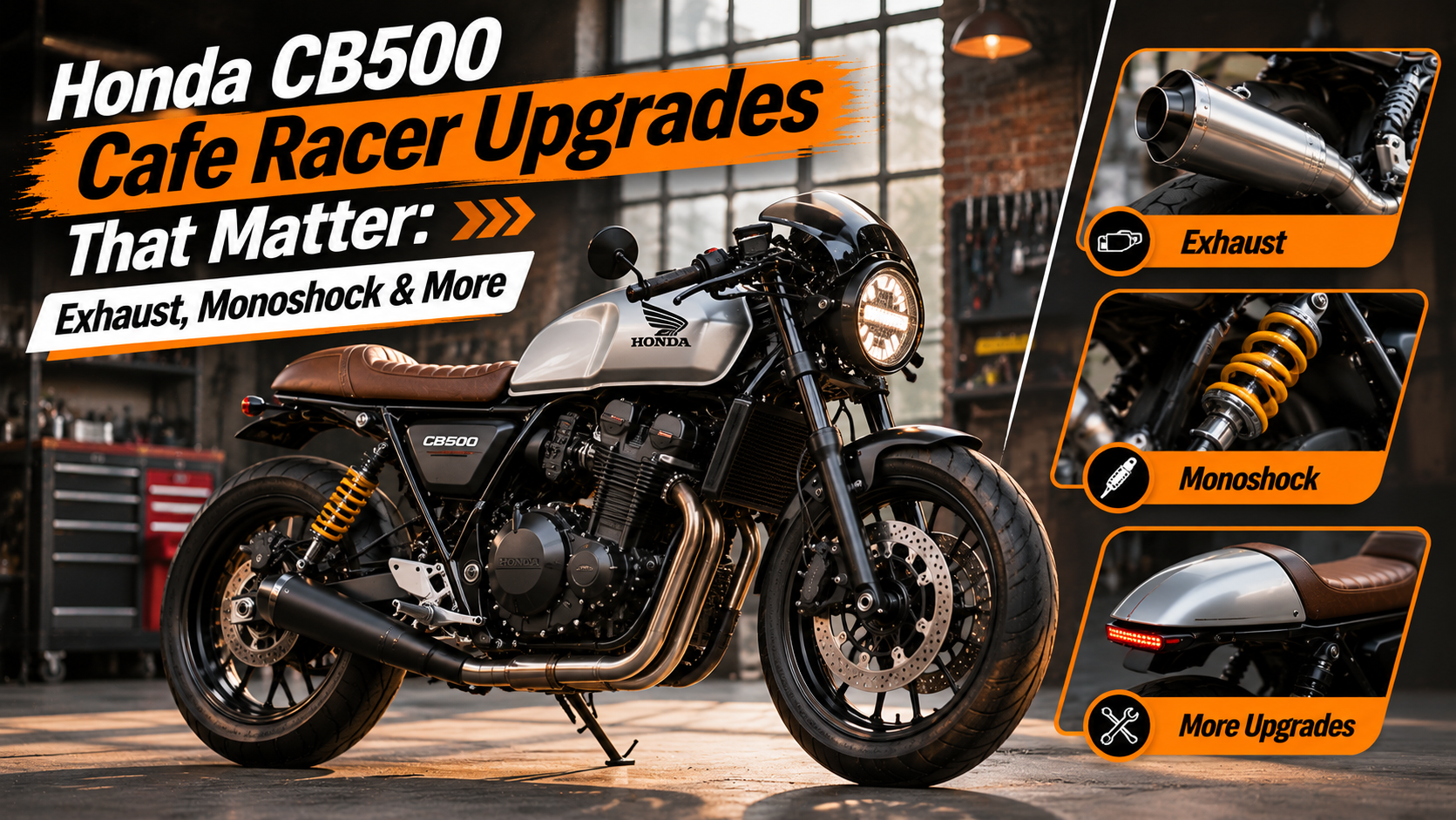
The upgrades that matter most on a Honda CB500 cafe racer are the exhaust, the rear suspension and the riding controls. A 4-into-1 exhaust changes the look, sound and weight of the bike. A monoshock conversion opens up the rear end for a cleaner profile and modern shock options. Rearsets move your feet back into a true cafe riding position. Seats, tails and fenders matter for style, but they should come after the mechanical work. If your engine needs attention, fix that first, because no bolt-on part can make up for a tired motor.
Why the CB500 Four Makes a Great Cafe Racer Donor
The Honda CB500 Four uses a 498cc air-cooled, single overhead cam inline-four with four carburetors. From the factory it wore a four-into-four exhaust and twin rear shocks with adjustable preload.
Honda built it from 1971, with US sales ending in 1973 when the CB550 replaced it. That family connection helps builders, because many parts are designed around the CB500, CB550, CB650 and CB750 together.
The cafe racer style itself is about stripping a bike down and tucking the rider in. Low bars, rearsets, a solo seat and swept pipes are the classic ingredients, which is why the CB500 Four suits it so well.
What to Check Before You Buy a Donor Bike
The cheapest CB500 is rarely the cheapest build. A clean, complete donor saves more money than any discount on parts.
A clear title that matches the frame number
An engine that turns over freely, ideally with a compression test
A straight frame with no cracked or bent mounts
Complete carburetors, since missing parts add cost fast
Stock CB500 vs Cafe Racer Build Goals
Before you buy anything, compare the stock bike with the build you want. The gaps show you where the money should go.
Upgrade 1: A Cafe Racer Exhaust That Fits the Build
The stock four-into-four exhaust is heavy and visually busy. Swapping to a 4-into-1 cafe racer exhaust is often the single biggest change you can make to how the bike looks and sounds.
A 4-into-1 gathers all four header pipes into one collector and a single muffler. That cleans up the right side of the bike and sheds pipework. Our Honda motorcycle exhaust buyer's guide covers the wider options if you are still deciding on a style.
Any exhaust change on a carbureted engine can affect fueling. Plan to check jetting and spark plug color after the swap, because a lean or rich engine will undo the benefit.
What to Look For in a CB500 Exhaust
Material: stainless steel resists rust far better than mild steel
Welding: full TIG welds signal careful, durable construction
Passenger clearance: some collectors crowd the passenger footpeg
Fitment: confirm the exhaust is made for your exact model and year
Sound and Weight: What to Expect
A 4-into-1 usually sounds deeper and more purposeful than four stock pipes, but the final note depends on the muffler, the packing and how the engine is tuned. Treat any sound or power claim as conditional until the bike is jetted and running well.
Weight savings depend on what you remove. Four pipes and four mufflers carry more metal than one collector and one can, so most builders notice a lighter right side.
The Kinetic CB 421 Exhaust
Kinetic's CB 421 exhaust system is made from 304 stainless steel and is 100% TIG welded, with a 4-1 collector manufactured in-house. It uses integrated flanges and a slip-fit joint between the collector and a fiberglass packed muffler.
It is listed for all CB 500, 550, 650 and 750 models, and it allows passenger foot clearance. Each one is made to order, with an average wait of two to four weeks, and Kinetic asks you to note your bike's year at checkout.
Upgrade 2: Converting to a Monoshock Honda Rear End
Twin shocks work, but they clutter the rear of the bike and limit your choice of modern suspension. A monoshock Honda conversion replaces them with a single shock, which cleans up the profile and opens the door to modern sportbike shocks.
Kinetic's suspension conversion kit is designed to use the stock swingarm. It includes CNC-cut steel frame and swingarm tabs, chromoly bracing, a shock brace and vertical brace with adjustable end-links, and a detailed instruction guide.
Kinetic states the kit is adjustable for height and length and does not interfere with fitting a wider tire. It is listed for the CB500, CB550, CB650 and CB750, starting at $650.
Single Shock or Dual Shock?
The kit accepts shocks between ten and twelve inches eye to eye. You can supply your own shock or choose from the options Kinetic offers at checkout.
Single shock: modern sportbike shocks of the GSXR, CBR, R6 or Ninja type
Dual shock: an option for builders who prefer a traditional look
Your own shock: the default option if you already have one that fits
Setting Up the Shock After Installation
Kinetic describes the conversion as fully adjustable at five points, which gives you room to tune ride height and geometry. That adjustability only helps if you use it.
Set rider sag for your weight before the first proper ride
Check that the tire clears the tail and fender through full travel
Recheck every adjustable end-link after the first few rides
Who Should Install It
This is a weld-on kit, not a bolt-on part, and Kinetic states that professional installation is required. Frame welding should be done by a qualified fabricator.
If you are new to suspension work, our guide to motorcycle suspension basics explains the terms before you start choosing parts.
Upgrade 3: Rearsets for a True Cafe Riding Position
Rearsets move your feet back and up, so you can tuck in behind lower bars. Without them, a cafe racer with clip-ons can feel cramped and awkward.
Kinetic's retro rearset mounts are a direct bolt-on for the Honda CB500, CB550 and CB650. They let you combine the original mounting point with most modern sportbike rearsets or universal sets, and they are CNC cut and powder coated in satin black.
Pair rearsets with your handlebar choice. Low bars with stock pegs, or rearsets with tall bars, both create an awkward position.
Choosing Bars to Match Your Rearsets
Clip-ons give the most committed cafe position, while low drag style bars keep things a little more relaxed for street riding. Both usually need cable and line lengths checked, because lower bars change the routing.
Clip-ons: most aggressive tuck, more weight on your wrists
Low bars: easier for longer rides and city traffic
Either way: confirm the throttle, clutch and brake lines reach without strain
Upgrade 4: Tail, Hoop and Finishing Parts
Once the mechanical upgrades are done, the tail section finishes the look. A tail hoop, short fender and solo seat give the bike its classic cafe profile.
Browse Honda suspension and chassis parts for tail hoops, a stubby fender and a tail hoop cover
Order finishing parts after the suspension work, since a monoshock conversion can change the space around the frame and tail
Check each listing for fitment, since not every part names specific models
Honda CB500 Cafe Racer Kit or Individual Parts?
Many builders start by searching for a honda cb500 cafe racer kit that bundles several parts in one box. A kit can save time on research, but it also commits you to someone else's idea of the finished bike.
A bundled kit suits you if:
You want a quicker, more predictable build
You are happy with a common style
You prefer fewer separate orders
Individual parts suit you if:
You want a specific exhaust, shock or riding position
You plan to upgrade in stages as budget allows
You want each part chosen for quality rather than convenience
Budgeting Your Honda CB500 Cafe Racer
Prices for labor, shocks and paint vary too much to quote fairly, so start with the parts you can price today. Using Kinetic's listed prices, the three core upgrades look like this:
CB 421 exhaust: $1,250
Suspension conversion kit: from $650, plus a shock and professional welding
Retro rearset mounts: $120, plus the rearsets you choose
Get a written quote for welding and fitting before you order the conversion kit. That number often decides whether the monoshock happens now or in a later stage of the build.
Kinetic Honda CB Parts at a Glance
Here is a quick reference of the Kinetic parts covered above, using the details listed on each product page.
The Right Order to Build Your CB500 Cafe Racer
Doing the work in the right order saves money and rework. If this is your first cafe racer build, this sequence keeps things manageable:
Get the engine, brakes and electrics healthy first
Do frame and suspension work, including any monoshock welding
Fit the exhaust and sort the jetting
Set up bars and rearsets together
Finish with the tail, seat, paint and lighting
Welding after paint ruins paint. That single rule is why suspension work comes before finishing.
What These Upgrades Will Not Do
Upgrades improve a healthy bike. They do not rescue a neglected one.
A new exhaust will not fix worn rings, valves or carburetors
A monoshock conversion does not guarantee better handling without proper setup
Performance claims depend on tuning, so treat any gain as conditional
None of these parts replace a qualified fabricator for frame work
Noise and Road Legal Checks
Rules on noise, lighting and equipment vary by state and city. Check your local requirements before you ride your build on public roads.
Confirm your exhaust meets local noise rules
Keep working lights and a visible, legal plate display
Ask your registration office whether frame modifications need inspection
Tell your insurer about major modifications
Final Thoughts
The upgrades that matter most on a Honda CB500 cafe racer are the exhaust, the rear suspension and the riding controls, done in that order after the engine is healthy.
If your budget is tight, start with a sorted engine and a quality exhaust. Leave the monoshock conversion until you can pay a professional to weld it properly.
Plan the build, buy in the right order, and you will finish with a bike that rides as good as it looks. Browse Kinetic's Honda parts to see what fits your CB.
Build Your CB500 With Kinetic Motorcycles
Kinetic Motorcycles designs and builds parts for vintage Honda CBs in Houston, Texas, from 4-into-1 exhausts to monoshock conversion kits and rearset mounts. If you are unsure what fits your bike, the team can confirm fitment before you order.
Visit www.kineticmotorcycles.com to start planning your build.
Frequently Asked Questions
-
Yes. The CB500 Four has an air-cooled inline-four, a simple layout and strong parts support shared with the CB550, CB650 and CB750. Condition matters most, so buy the healthiest bike you can afford before spending on upgrades.
-
Most builders mean the 1970s CB500 Four, the 498cc air-cooled inline-four. Later CB500 twins are different bikes with different parts. Confirm the exact model and year before ordering exhausts, suspension or controls for your build.
-
Often, yes. A new exhaust changes airflow, which can make a carbureted engine run lean or rich. Check spark plug color and how the bike runs, and ask a carb specialist to adjust the jetting if needed.
-
Yes, for the Kinetic kit. It is a weld-on conversion that uses the stock swingarm, and Kinetic states professional installation is required. Have a qualified fabricator do the welding before any paint or finishing work begins.
-
The Kinetic kit accepts shocks between ten and twelve inches eye to eye. You can supply your own or choose a single modern sportbike shock, such as GSXR, CBR, R6 or Ninja types, or a dual shock option.
-
Kinetic's retro rearset mounts are listed as a direct bolt-on for the Honda CB500, CB550 and CB650. They work with most modern sportbike rearsets and universal sets. Confirm your exact model before ordering any rearset parts.
-
A kit is worth it if you want a faster build with a common style. Individual parts suit builders who want a specific exhaust, shock or riding position, or who plan to upgrade in stages over time.
-
The CB 421 exhaust is made to order, with an average wait of two to four weeks. Kinetic suggests emailing contact@kineticmotorcycles.com for the current queue, and asks you to note your bike's year at checkout.
Is the Honda CB500 a Good Cafe Racer Base?
Yes. The CB500 Four has an air-cooled inline-four, a simple layout and strong parts support shared with the CB550, CB650 and CB750. Condition matters most, so buy the healthiest bike you can afford before spending on upgrades.
Which CB500 Is Best for a Cafe Racer Build?
Most builders mean the 1970s CB500 Four, the 498cc air-cooled inline-four. Later CB500 twins are different bikes with different parts. Confirm the exact model and year before ordering exhausts, suspension or controls for your build.
Do I Need to Rejet the Carbs After an Exhaust Change?
Often, yes. A new exhaust changes airflow, which can make a carbureted engine run lean or rich. Check spark plug color and how the bike runs, and ask a carb specialist to adjust the jetting if needed.
Does a Monoshock Honda Conversion Require Welding?
Yes, for the Kinetic kit. It is a weld-on conversion that uses the stock swingarm, and Kinetic states professional installation is required. Have a qualified fabricator do the welding before any paint or finishing work begins.
What Shock Do I Need for a CB500 Monoshock?
The Kinetic kit accepts shocks between ten and twelve inches eye to eye. You can supply your own or choose a single modern sportbike shock, such as GSXR, CBR, R6 or Ninja types, or a dual shock option.
Will Rearsets Fit My Honda CB500?
Kinetic's retro rearset mounts are listed as a direct bolt-on for the Honda CB500, CB550 and CB650. They work with most modern sportbike rearsets and universal sets. Confirm your exact model before ordering any rearset parts.
Is a Honda CB500 Cafe Racer Kit Worth It?
A kit is worth it if you want a faster build with a common style. Individual parts suit builders who want a specific exhaust, shock or riding position, or who plan to upgrade in stages over time.
How Long Does the Kinetic CB 421 Exhaust Take to Build?
The CB 421 exhaust is made to order, with an average wait of two to four weeks. Kinetic suggests emailing contact@kineticmotorcycles.com for the current queue, and asks you to note your bike's year at checkout.