
Harley Exhaust Systems: How to Choose the Right Setup for Your Bike

Most riders shopping for Harley exhaust systems are chasing two goals at once and often assume they are the same thing.
They are not.
A louder exhaust is a design choice. Better performance is a tuning choice. Depending on what you buy, you may get one, both, or neither. That is why choosing the right Harley exhaust system involves more than listening to sound clips or comparing product photos.
Many riders install a new exhaust expecting instant horsepower, only to discover that without the right fuel tune or setup, the motorcycle may sound better while delivering little or no improvement in performance. Understanding the differences between exhaust designs before buying helps avoid costly mistakes.
This guide answers the eight questions that matter most when selecting a Harley-Davidson exhaust system, including:
Whether a slip-on or full exhaust system is the better choice for your riding style.
The differences between 2-into-1 and 2-into-2 exhaust systems and how each affects performance, sound, and rideability.
How exhaust materials, tuning requirements, fitment, and legal considerations influence your purchase.
The true cost of upgrading, including installation and supporting modifications.
You do not need to be a mechanic to choose the right setup. You simply need to know which questions to ask and how to evaluate the answers before spending your money. This guide explains what matters, what does not, and how to select the best Harley exhaust system for your motorcycle with confidence.
What Do Harley Exhaust Systems Actually Change?
Two things change the moment the bolts are tight: the bike sounds substantially better, and it loses several pounds of weight carried high on the frame. Two more depend entirely on fuelling. Stronger mid-range and sharper throttle response only appear once the air-fuel ratio is corrected for the new flow. Fitted without a tune, a new system often feels flatter than stock at low revs, which is why so many riders blame a perfectly good pipe. Budget the tune with the pipe and all four arrive together.
Take them in order and the choice makes itself. Skip one and you are relying on a product photograph to answer a question it cannot answer.
Why the Factory System Sounds the Way It Does
The system fitted at the factory is engineered around noise regulations, emissions compliance and production cost. Harley-Davidson has to meet all three on every bike that leaves the line.
Meeting them means tight bends, heavy internal baffling and thick-walled tube. The gas path is deliberately slowed and the assembly is heavy for what it does.
Neither is a fault. Both are choices made for reasons that have nothing to do with how the bike feels to ride, and both are what an upgrade unwinds.
It is worth understanding before you shop, because it reframes the purchase. You are not buying horsepower off a shelf. You are removing a designed-in restriction, then paying separately for the calibration that lets the engine use the room you created.
The Eight Questions That Decide Your Harley Exhaust
Slip-On or Full System?
A slip on exhaust Harley setup replaces the mufflers only and bolts onto the factory head pipes. A full system replaces everything from the headers back.
Slip-ons are the accessible route. Basic tools, usually under two hours, lower cost, and reversible in an afternoon. That reversibility matters more than riders expect, because it makes a slip-on a low-risk way to find out what tone you actually want. Most of the slip-on range covers the volume model years.
Full systems open the entire gas path, which is where meaningful airflow gains come from, and they save more weight. They also demand tuning rather than merely benefiting from it. If you are looking at full system options, budget the calibration at the same time.
One caution on cost comparisons. A slip-on plus a tune often lands close to a bare full system, so compare complete setups rather than headline prices when weighing Harley exhaust systems against each other.
2 Into 1 or 2 Into 2?
A 2 into 1 Harley exhaust merges both cylinders into a single collector. That tends to build mid-range on a V-twin and usually saves the most weight, which is why performance-focused riders gravitate to it.
A 2 into 2 keeps the pulses separated to two outlets. Many riders prefer it for low-end response and for the traditional twin-pipe look that defines the silhouette of the bike.
Neither is universally faster. If you ride mostly in town and value response off the line, a 2 into 2 rewards that. If you spend time at highway speeds and want stronger roll-on in the middle of the range, a 2 into 1 usually suits better.
Ground clearance and heat routing follow from the layout too. A tucked 2 into 1 usually keeps more clearance on a low bike, while twin pipes can put more heat near your right leg in slow traffic. Check the routing against your controls and any lowering you have done.
What Material Is It Built From?
Ask for the grade as a number rather than a description like premium stainless steel. Material predicts how the pipe looks in three years better than the brand name does.
Wall thickness matters alongside it. Thicker wall adds weight and survivability. Thinner wall saves weight and is more prone to dents and to cracking around welds and mounts.
Two more questions. Are the bends mandrel bent, which keeps internal diameter constant through the curve, or crush bent, which restricts flow at every bend? And are the joints TIG welded consistently, with interior welds back-purged? Un-purged interior welds corrode from the inside out, and that is what fails first.
Ask for close photographs of the welds and the inside of the muffler outlet before ordering. Sellers confident in their supplier send them without hesitation, and the ones who hesitate have told you something useful about what you would be buying.
How Will It Actually Sound?
Tone comes from geometry. Baffle design, core diameter, muffler length and volume, and collector shape set the character. Two systems with the same internals sound close to identical whatever the badge says.
Volume and depth are separate outcomes. A straight pipe is loud and thin. Well-baffled Harley mufflers can measure quieter while sounding considerably richer, which is usually what riders actually want.
Three questions verify sound before you pay:
Which baffle or core is fitted as standard?
Can it be swapped later if the system is louder than you expected?
Is there a recording on the same model with the same control position?
Live with the answer. A note that thrills for ten minutes can wear thin on a two-hour ride, and long rides decide whether you keep a system.
One more warning. Sound clips are recorded with chosen microphones, at chosen distances, at chosen revs. A clip tells you the character of Harley exhaust systems. It does not tell you how that pipe feels at 6am in a quiet street or after two hours on a motorway.
Does It Need a Fuel Tune?
Almost always, yes. Changing exhaust flow shifts the air-fuel ratio the engine was calibrated around. On fuel-injected bikes that means a remap or a fuel management module. On earlier carburetted models it means rejetting.
Skip it and the engine runs lean. Lean running costs throttle response, raises cylinder temperatures and can cause real damage over time, which matters more on an air-cooled engine than a liquid-cooled one.
When a seller quotes horsepower, ask one question: was that figure recorded on a dynamometer before or after tuning, and on which model year? A chart with no stated tune is not evidence of anything.
There is a practical test after fitting and tuning. Hold a steady throttle in third gear from around 2,500 rpm. If the bike surges or hunts, the calibration is unfinished, whatever the pipe is doing.
Will It Fit Your Exact Bike?
Fitment is the most common reason a purchase goes wrong. Harley exhaust pipes are designed around a specific frame, a specific engine platform and a specific control position, and all three vary across the range.
Softail, Touring, Dyna and Sportster families do not share systems. Within a family, model years bring changes that move mounting points. Mid controls, forward controls and rearsets each need different routing on the same frame.
A listing that says fits most Harleys is not a fitment statement. Get your exact year, model and control position confirmed in writing, or check it against a model fitment guide before ordering.
Is It Road Legal Where You Ride?
Replacement motorcycle exhausts sold in the United States are federally regulated. The rules sit in 40 CFR Part 205, Subpart E, covering labelling, noise standards and tampering.
Every replacement system distributed in the US must carry a permanent compliance label identifying the manufacturer and the standard it meets. No label is a warning about the seller.
Competition-only systems must state that they do not conform to EPA noise emission standards and that road use constitutes tampering.
After the federal acoustical assurance period, state noise limits govern, and they vary. Many systems are marked as not legal for use in California.
None of this makes an aftermarket Harley exhaust illegal. It makes uninformed buying expensive, and checking takes five minutes.
Insurance and inspection are worth a thought as well. A compliant, labelled Harley Davidson exhaust keeps that conversation short if it ever comes up, and an unlabelled one invites questions you would rather not answer at the roadside.
What Does the Whole Job Cost?
The price on the product page is rarely the price of the change. Budget for the system, the fuel tune, fitting if you are not doing it yourself, new gaskets and clamps, and often a high-flow air filter so the intake matches the new flow.
Riders who budget only for the pipe are the ones who run it untuned, dislike the result and buy again within the year. That is the most expensive route of all.
Also check what is in the box before ordering. Missing gaskets, the wrong clamps or heat shields sold separately turn a Saturday job into a two-week wait for hardware.
Recommended Harley Exhaust Systems from Kinetic Motorcycles
Every system below is handmade in Houston from mandrel-bent 304 stainless, fully TIG welded in house, and internally ceramic coated. All are made to order. Prices shown are starting prices and vary with the options you choose.
1.Vertical Twins, Symmetrical 2 into 2 Exhaust for Sportster - $650.00https://drive.google.com/file/d/10F4j1yTSu3wmABP4BHJEWvg-QyO89d2X/view?usp=sharing
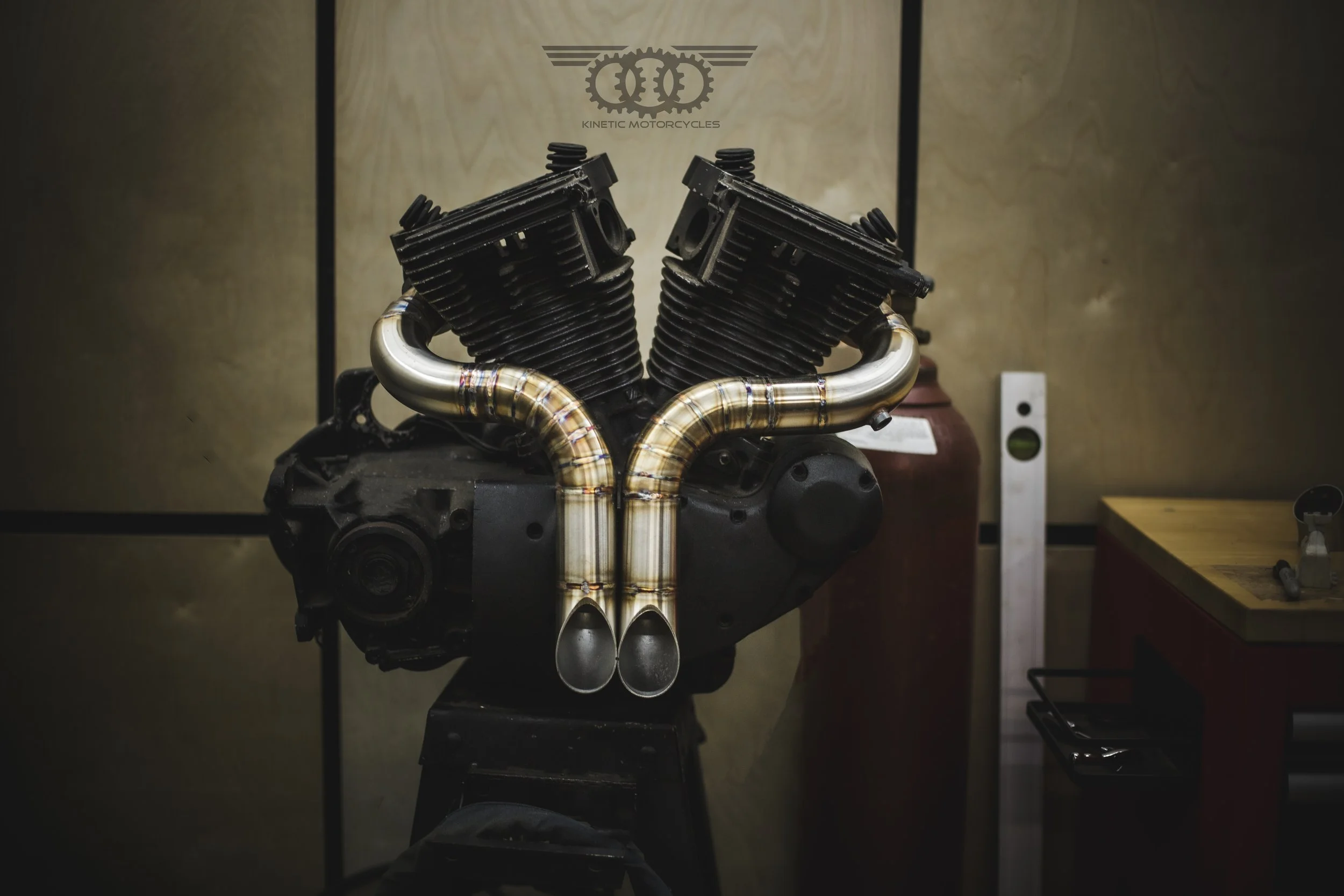
The most forgiving fitment in the range. It covers 1986 to 2020 plus Sportsters and clears rear-sets, mid controls and forward controls, which is the exact question most systems fail. Segmented pie-cut welds and tip style are optional, so you set the look.
2. Double Down, Forward-Pushed 2 into 2 Exhaust for Sportster - $650.00
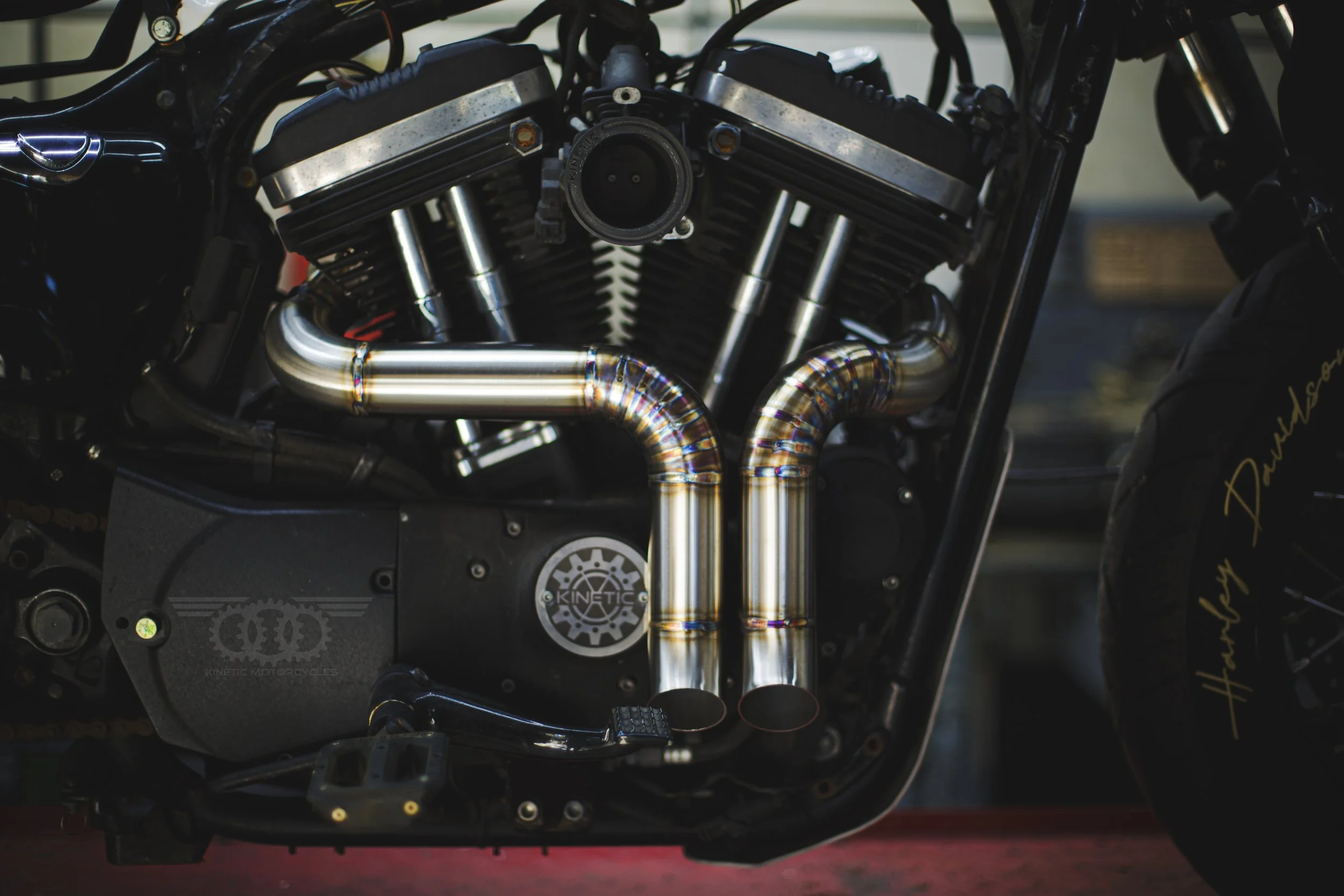
Built on the Vertical Twins with the pipes pushed forward. Choose it when you are on mid controls or rearsets rather than forward controls, and you want a more aggressive stance without moving to a full 2 into 1.
3.The Sidewinder, 2 into 2 Exhaust with 45 Degree Exits - $750.00
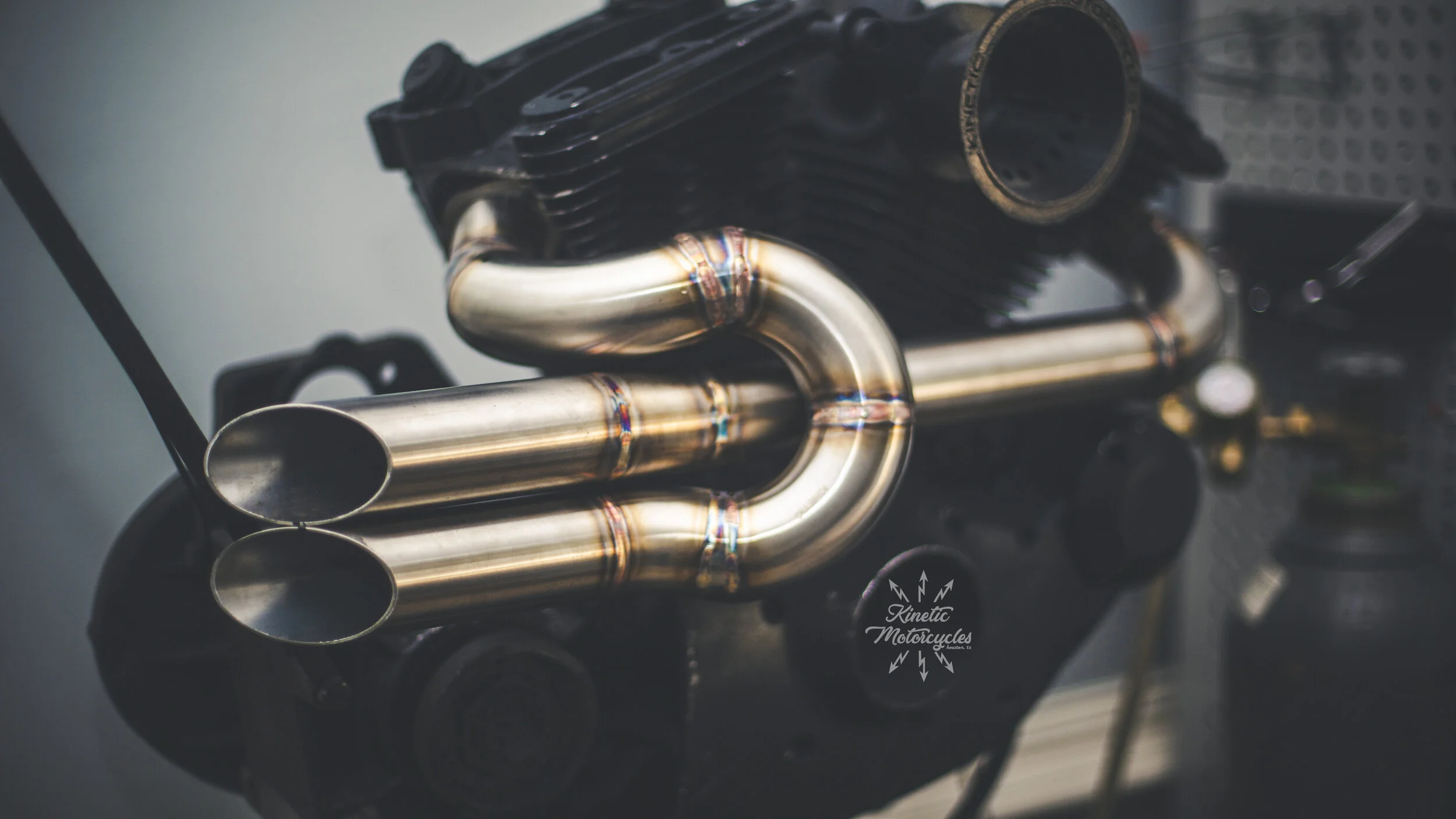
Precision-cut 45 degree exits push flow away from the rear of the bike while staying passenger friendly. A sensible pick if you ride two-up and still want an aftermarket Harley exhaust with real presence.
4. 21 Sidewinder, 2 into 1 Exhaust with Resonated Muffler - $750.00
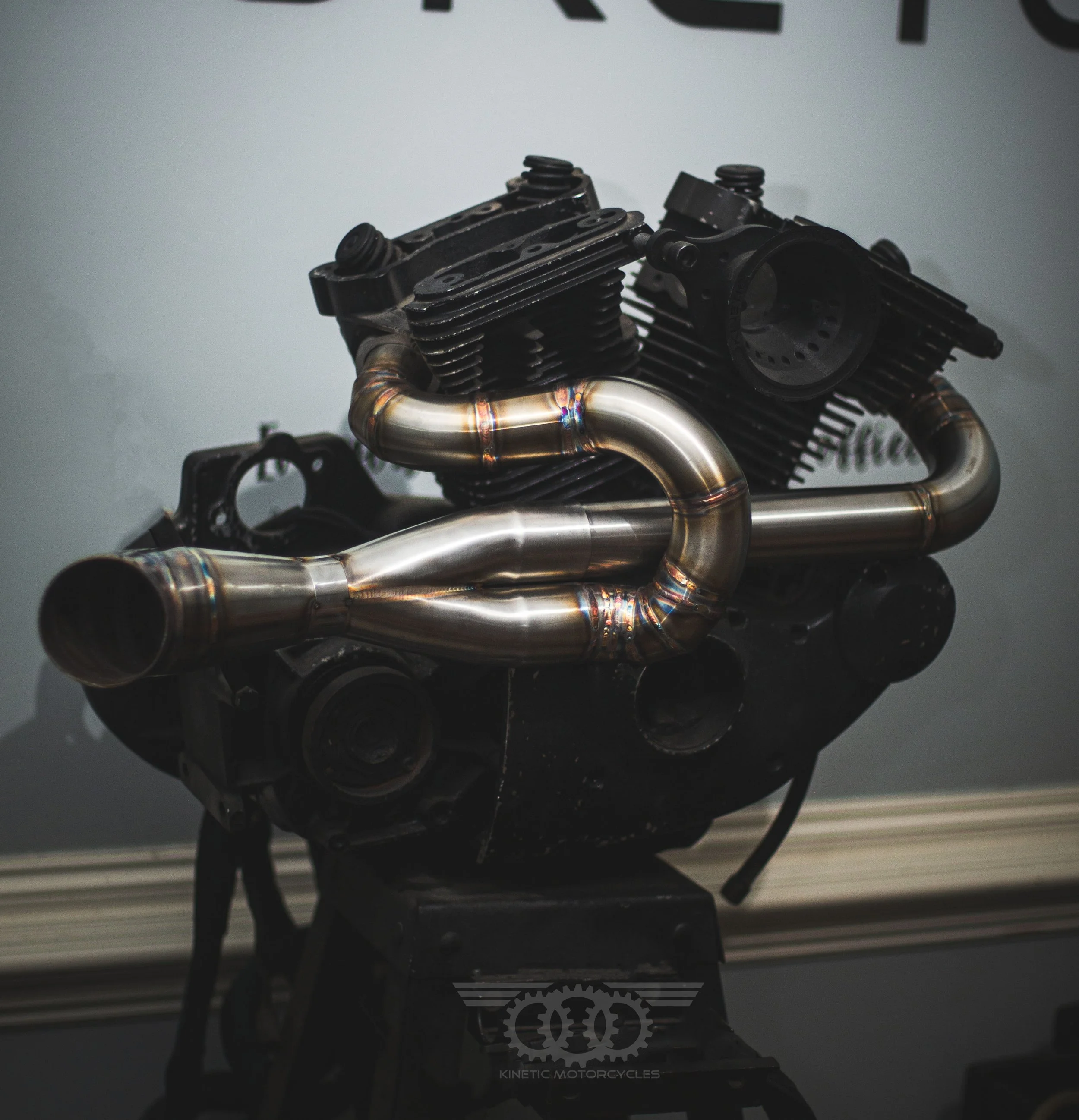
The 2 into 1 Harley exhaust in the range. A smooth merge collector feeds a resonated stainless muffler, so you get the mid-range that a single collector builds with a more refined note than a straight-through design.
If your bike or your build sits outside these fitments, thecustom fabrication services page covers one-off work, and theMufflers and Exhaust section carries universal slip-on mufflers for keeping headers you are happy with.
What a New Exhaust Will Not Do
It will not turn one model into another. Displacement, gearing and engine character are unchanged.
It will not add power by itself, and fitted without tuning it frequently feels worse below 3,000 rpm than the system it replaced.
It will not compensate for neglected servicing. If the bike is due valve adjustment or has an intake leak, fix that first. A new pipe on a tired engine makes existing problems easier to hear.
And it will not stay quiet as it ages. Baffles break down, packing burns out, and a system that measured acceptably when new can drift louder over several seasons of hard use.
Final Thoughts
Two gains arrive the moment the system is bolted on: weight and sound. The rest arrive when the fuel is corrected. That distinction explains almost every disappointed review of a good product. The pipe was fine. The calibration was missing.
The riders happiest with their Harley exhaust are rarely the ones who spent the most. They are the ones who matched the system to the bike they own and the way they ride, then paid for the tune that made it work.
Write down your exact year, model and control position, then ask two sellers the eight questions above and compare the answers rather than the photographs. The replies will tell you more than any review page.
Ready to Upgrade? Explore Kinetic Motorcycles
Kinetic Motorcycles offers a curated range of Harley exhaust systems chosen for build quality, verified fitment and honest sound, with guidance available before you order rather than after.
Visit www.kineticmotorcycles.com to explore your options or ask for a fitment check on your exact model.
Frequently Asked Questions
-
Slip-on exhausts improve sound and appearance at a lower cost with simple installation. Full exhaust systems replace headers and deliver greater airflow and performance potential, especially when paired with a proper fuel tune and supporting modifications.
-
A performance exhaust alone adds little power. When combined with a fuel tune and high-flow air filter, it typically improves mid-range torque, throttle response, and rideability rather than producing significant peak horsepower gains.
-
A 2-into-1 exhaust merges both cylinders for improved mid-range torque, lighter weight, and highway performance. A 2-into-2 system keeps separate pipes, offering a traditional Harley appearance and stronger low-end response for many riders.
-
Yes. An aftermarket exhaust changes engine airflow, making the factory fuel calibration less effective. Retuning restores the correct air-fuel ratio, improves throttle response, reduces engine temperatures, and helps prevent long-term performance or reliability issues.
-
Some aftermarket Harley exhausts are street legal, while others are designed only for competition. Always verify EPA compliance labels, state noise regulations, and California restrictions before purchasing or installing an exhaust system.
-
304 stainless steel offers the best durability, corrosion resistance, and heat tolerance. 409 stainless is more affordable but discolors faster, while chrome-plated mild steel is economical yet more vulnerable to rust once its protective finish is damaged.
-
Exhaust loudness depends mainly on baffle and core design, not price or brand. Well-designed mufflers produce a deeper, richer sound, while interchangeable baffles allow riders to adjust exhaust volume to their preference over time.
-
No. Harley exhausts are designed for specific models, years, and control configurations. Always confirm compatibility with your motorcycle's exact model, production year, and foot control setup before purchasing or installing an exhaust system.