
Handmade vs Mass-Produced Custom Sportster Exhausts: Which Is Worth Buying?
You bought the pipe because of a sound clip.
Three weeks later, the bike sounds thinner than the clip did, the header sits half an inch off your rearset, and you are back on a product page pricing a second system.
That mistake almost never traces back to a bad brand. It traces back to the wrong production method for the bike in your garage. A custom Sportster exhaust changes sound, looks, and power delivery at once, so it is the first modification most owners make and the one they most often buy twice.
Handmade and mass-produced are not a good tier and a bad tier. They are two manufacturing models, and each one handles badly the exact thing the other handles well.
Here is what actually decides which one you should buy:
Material grade, wall thickness, and weld quality
Fitment across four different Sportster platforms
Sound character and whether you can verify it before paying
Real performance and the tuning it depends on
Price versus lead time
What the pipe does to resale value
No brand rankings. Just a practical comparison to help you choose the right custom Sportster exhaust for your motorcycle.
Choosing the Right Sportster Exhaust
For most Harley-Davidson Sportster owners, a mass-produced Sportster exhaust is the better choice because it offers proven fitment, verified sound, warranty support, and faster availability. A handmade Sportster exhaust is the better investment when your motorcycle has a modified frame, rearsets, custom controls, or a rare model year that standard production systems cannot accommodate. The right choice depends on your motorcycle's configuration, riding style, budget, and long-term performance goals. By understanding how each manufacturing method affects fitment, performance, durability, and ownership experience, you can confidently choose an exhaust that suits your build instead of replacing it later.
What Handmade and Mass-Produced Mean in a Custom Sportster Exhaust
Handmade means the system is fabricated per order by a person. Mass-produced means it is replicated in batches to a fixed pattern. That is the whole distinction.
It matters because the method decides what the pipe can adapt to. A batch system is locked to the pattern it was validated against. A hand-built system is only locked once it is welded.
How a Handmade Sportster Exhaust Is Built
A handmade Sportster exhaust starts as straight tube and mandrel-bent elbows that a fabricator fits against a jig or against your actual bike. Merge collectors are hand-formed, brackets are made for that frame, and welding is almost always TIG, properly called gas tungsten arc welding, because thin-wall stainless needs that level of control.
Because it is built after you order, the design stays open. Routing can move to clear rearsets, a modified frame or an oversized tire. That is why Ironheads, hardtails and one-off frames end up here, at the point where the catalogs stop.
The cost is time and variability: two systems from the same builder are similar, not identical.
How a Mass-Produced Sportster Exhaust Is Built
A mass-produced system is CNC bent, welded in fixtures that hold every joint in the same place, and built in runs that sit in a warehouse. Fitment is validated once against a defined model list, then repeated.
That buys stock availability, sound recordings on your exact model year, dyno charts, returns and warranty. It also buys consistency: the pipe that arrives matches the pipe in the video.
The cost is rigidity. If your bike sits outside that fitment list, no amount of bracket improvisation turns the install into a clean one.
Why the Label on the Product Page Tells You Nothing
Both camps use identical vocabulary. Large brands call catalog systems handcrafted because a person does the final weld, and small builders advertise made-to-order lead times while using the same CNC-bent tube.
Ignore the adjectives and read the specification. Six data points tell you what you are actually buying:
Material grade, stated as 304 or 409 stainless, or as mild steel
Wall thickness, stated in inches or millimeters
Bend method, mandrel or crush
Weld type, and whether interior welds are back-purged
Exact fitment list by year, model and control position
Lead time, warranty length and return policy
A seller who answers all six in writing is worth buying from. One who answers none is selling you a photograph.
Where Handmade and Mass-Produced Sportster Exhausts Actually Differ
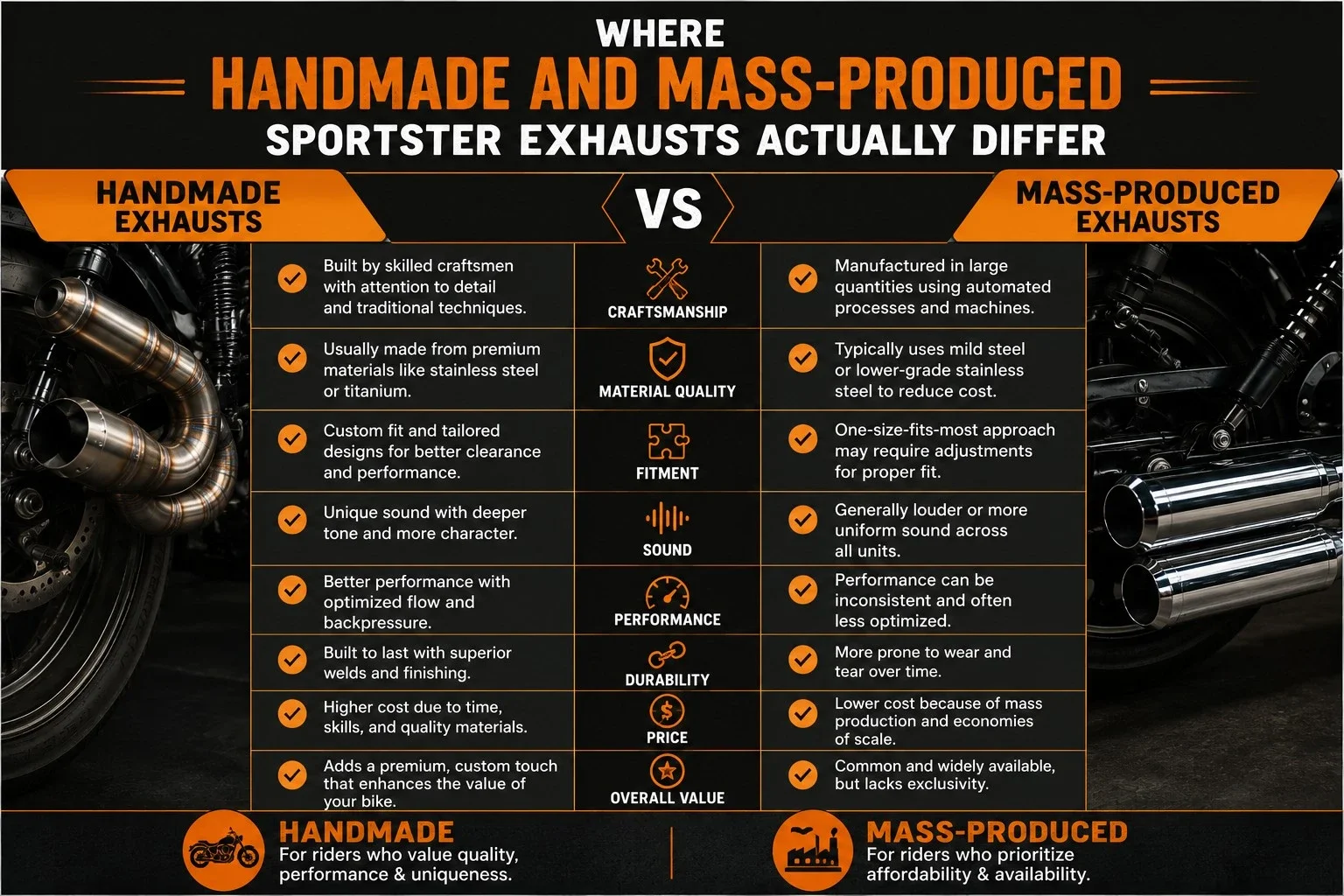
Materials, Wall Thickness and Welding
On any custom Sportster exhaust, material grade predicts durability better than production method does, and most buyers never ask for it.
304 stainless resists corrosion and repeated heat cycling, can be left raw, brushed or polished, and does not depend on a coating to survive. It costs the most. If you ride in all weather, buy it.
409 stainless holds up but discolors faster, so it is usually coated. Mild steel is cheapest and depends entirely on ceramic coating or chrome. Once that layer chips it rusts, which suits show bikes and punishes daily riders.
Wall thickness sets weight and durability before any baffle is chosen. Bend method matters more: mandrel bending keeps internal diameter constant through the curve, while crush bending pinches the radius and restricts flow at every bend.
Welding is where a handmade Sportster exhaust earns its premium, but only sometimes. What fails on either side is inconsistent penetration and un-purged interior welds that corrode from the inside out. Ask for close photographs of the welds
Fitment Across Sportster Generations
Fitment is the biggest reason to pick one method over the other, because the Harley-Davidson Sportster is not one platform. It is four.
Control position adds a second layer. Mid controls, forward controls and rearsets each need different routing on the same frame, and a system built around mid controls will foul a rearset install.
Catalog coverage of the Harley Sportster exhaust market is strongest across the volume years, particularly the 2004 to 2022 XL883 and XL1200. Outside that range it thins fast, and Ironheads, hardtails and one-off frames are where hand fabrication becomes the only workable answer.
Sound Character and Volume
Sound comes from geometry, not from who held the torch. Baffle design, core diameter, muffler length and merge shape set the tone. Two pipes with the same internals sound close to identical.
Volume and tone are separate variables, and conflating them is the most common buying error I see. A straight pipe is loud and thin. A well-baffled 2-into-1 is quieter and deeper.
This is where mass production wins outright. You can hear the exact system on your model year before spending anything. Ask three questions before you commit:
Which baffle or core is fitted as standard?
Can it be swapped later if the pipe turns out louder than you expected?
Can you hear a recording of the same model year with the same control position?
Treat deep, aggressive and throaty as sales copy until a recording backs them up.
Performance, Tuning and Real Dyno Numbers
A performance Sportster exhaust does not add power on its own. It can remove it.
Changing exhaust flow shifts the air-fuel ratio the engine was calibrated around. Without a matching fuel tune, the engine runs lean. That costs throttle response, raises temperatures and can do real damage.
Layout adds a second trade-off. A 2-into-1 merges both pulses into one collector, builds mid-range and usually saves weight. A 2-into-2 keeps them separated for low-end response and the traditional look. Neither is universally faster.
The one undisputed gain from a performance Sportster exhaust is weight. Stock systems are heavy, and a stainless replacement removes several pounds high on the bike. When a seller quotes horsepower, ask whether the figure was recorded before or after tuning.
Price, Lead Time and Resale Value
Prices overlap between the two camps, so the real difference is time. A catalog system ships from stock and you ride that week. A handmade system enters a build queue, usually several weeks for raw stainless, with polished or coated finishes adding more.
Get that lead time confirmed in writing before you pay a deposit.
Resale splits cleanly. A known-brand system sells quickly secondhand because the next buyer can verify fitment and hear a clip. A rare custom Harley exhaust either sells strongly to the one person who wants that design, or sits for months.
Which Custom Sportster Exhaust Is Worth Buying for Your Build
A mass-produced Harley Sportster exhaust is worth buying for a standard bike on standard controls. A handmade one is worth buying when the bike, the routing or the timeline falls outside what a catalog was built to serve.
Buy a Mass-Produced System If This Describes You
You ride a 2004 to 2022 XL883 or XL1200 that is stock or lightly modified
You want the bike sounding right within two weeks, not two months
You want to hear the system and keep a return window open
It is your first exhaust and you are still deciding on tone
You expect to sell the bike within a few years
Buy a Handmade System If This Describes You
Your bike has rearsets, a modified or hardtail frame, or a model year the catalogs skip
You want a routing, stance or tip position no production part achieves
The pipe is a defining visual element of the build, not an upgrade
You have seen the fabricator's previous work up close
You would rather wait than compromise the line of the bike
The Five-Point Decision Checklist
Before money changes hands on a custom Sportster exhaust, get these five confirmed in writing:
Fitment: your exact year, model and control position, named explicitly
Material: grade and wall thickness, given as numbers
Sound: a recording on the same model, plus the baffle spec
Tuning: what fuel management the seller expects alongside it
Compliance and delivery: labeling status, lead time and warranty terms
If a seller will not put all five in a message you can keep, that is your answer about the seller.
The Legal Side of Aftermarket Sportster Exhaust Most Buyers Skip
Any aftermarket Sportster exhaust sold in the United States is federally regulated, and most buyers never check. The rules sit in 40 CFR Part 205, Subpart E, covering labeling, noise standards and tampering.
Four things matter at the point of purchase:
Labeling. Every replacement exhaust distributed in the US must carry a permanent label identifying the manufacturer and the standard it meets. No label is a warning about the seller, not a bargain.
Competition-only parts. Closed-course systems must state that they do not conform to EPA noise standards and that road use constitutes tampering. Read the listing.
Tampering. Federal rules prohibit modifications that push the bike past the federal noise standard, and name removing or puncturing baffles and mufflers.
State limits. After the federal acoustical assurance period, state noise limits govern. Many systems are marked as not legal for use in California.
None of this makes aftermarket exhaust illegal. It makes uninformed buying expensive.
Questions to Ask Any Builder Before You Pay
Copy these into your first message to any custom Sportster exhaust seller, handmade or production:
What material grade and wall thickness is the system built from?
Are the bends mandrel bent and the interior welds back-purged?
Does it fit my exact year, model and control position?
Can you send a sound recording of this system on that same model?
Which baffle or core is fitted, and can it be changed later?
What fuel tuning do you recommend alongside this system?
Does the system carry the required compliance label?
What is the lead time, the warranty period and the return policy?
The quality of the replies will tell you more than any review page.
Final Thoughts
Buy mass-produced when your bike is standard and your priority is a verified result quickly. Buy handmade when your bike is not standard and your priority is a result nothing off the shelf can give you.
One condition flips this more often than any other: control position and frame modification. A stock frame with stock controls puts the whole catalog in play, so hand fabrication buys mostly exclusivity. Rearsets, a hardtail or a pre-1986 model narrows the catalog to almost nothing.
Write down your exact year, model and control position, send the eight questions above to two sellers, and compare the answers rather than the photographs.
Ready to Upgrade Your Sportster? Explore Kinetic Motorcycles
Kinetic Motorcycles offers a curated range of custom Sportster exhaust systems built for real sound and performance gains, with fitment confirmed before you buy.
Visit www.kineticmotorcycles.com to explore your options or get advice on the right setup for your bike.
Frequently Asked Questions
Is a handmade Sportster exhaust worth the extra cost?
A handmade Sportster exhaust is worth it when you need a specific routing, a rare model fit, or a finish no catalog offers. For a stock bike wanting better sound, a mass-produced system delivers most of that value.
Will a custom Sportster exhaust increase horsepower?
Only with a matching fuel tune. Changing exhaust flow shifts the air-fuel ratio, so gains on an untuned bike are small and can turn into low-end torque loss. Tune the bike, then measure on a dyno.
Are aftermarket Sportster exhausts street legal?
It depends on the system. Federal rules under 40 CFR Part 205 require replacement motorcycle exhausts to carry a compliance label, and states set their own noise limits. Competition-only pipes are not legal on public roads.
What is the difference between 304 stainless and mild steel Sportster exhaust?
304 stainless resists corrosion, holds heat cycling well, and can be left raw, brushed, or polished. Mild steel costs less but relies on ceramic coating or chrome to survive, and it rusts quickly once that layer chips.
How long does a handmade Sportster exhaust take to arrive?
Most builders quote two to six weeks for raw stainless, with polished or coated finishes adding several more weeks because the parts leave the shop for finishing. Confirm the current lead time in writing before ordering.
Does a Sportster exhaust from 2004 onwards fit a 1986 to 2003 model?
Usually not. Harley redesigned the Sportster frame in 2004 with rubber engine mounts and revised mounting points, so header routing differs. Always match the system to your exact year, model, and control position before buying.
Is a handmade Sportster exhaust harder to resell?
Handmade pipes hold value with buyers who want that exact look, but the audience is smaller. Mass-produced systems from known brands sell faster secondhand because fitment, sound clips, and reviews are easy for the next owner to verify.